

Samsung Electronics and SK hynix are each developing Compute Express Link (CXL) technologies to create a new memory tier for AI systems.
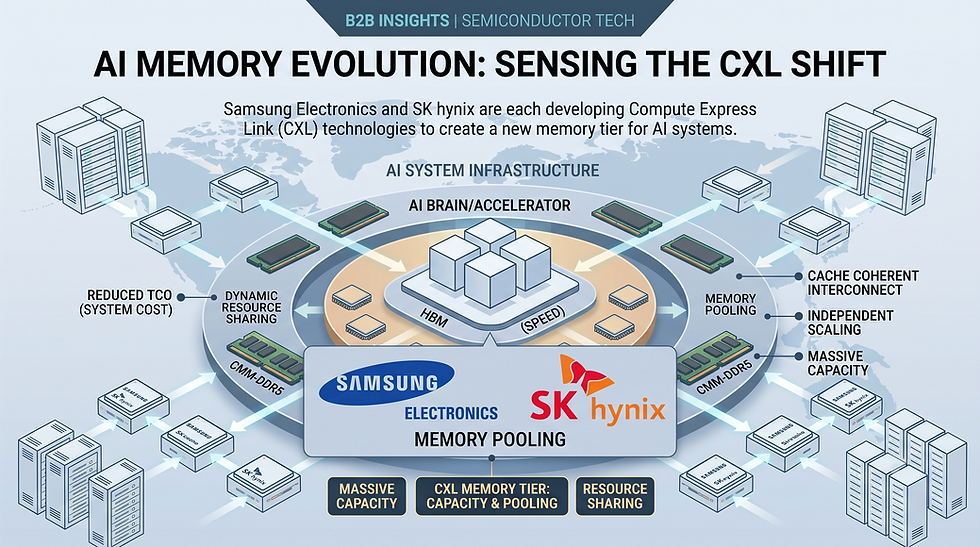
Samsung Electronics and SK hynix are each developing Compute Express Link (CXL) technologies to create a new memory tier for AI systems.
South Korean memory giants Samsung Electronics and SK hynix are advancing the development of Compute Express Link (CXL) technologies to introduce a new memory tier for artificial intelligence (AI) systems. As the AI industry encounters the capacity limits of simply appending more High-Bandwidth Memory (HBM) directly to processors, companies are shifting focus toward modifying system architectures. CXL serves as an open standard interface that connects processors and memory, slotting between conventional DRAM and solid-state storage. This technology provides substantial memory expansion without requiring operators to purchase additional, costly processors just to accommodate more memory.
SK hynix has actively demonstrated its CXL capabilities, recently unveiling its Inference Memory Tier Expansion (IMTE) architecture. This architecture restructures AI memory systems by adding CXL hybrid memory between existing HBM or DDR memory and solid-state drives. By predicting hot data and retrieving it from storage ahead of time, this structure improved AI inference efficiency by 35.7% in SK hynix's testing. Furthermore, the company showcased a second-generation 256-gigabyte CMM-DDR5 module based on the latest CXL 3.2 standard at the HPE Discover conference in Las Vegas in June, though it has not yet confirmed a mass production timeline.
Samsung Electronics is also aggressively pursuing the commercialization of its CXL offerings, targeting the mass production of its CXL Memory Module-DRAM (CMM-D) 3.0 within the year. This next-generation module will utilize the CXL 3.2 specification, which introduces the CXL Hot Page Monitoring Unit (CHMU) to optimize data placement by monitoring access frequency in real-time. According to company tests, a 1-terabyte CXL memory pool reached approximately 92% of the inference performance of standard DRAM while supporting much larger caches. Samsung aims to be the first in the industry to mass-produce a CXL 3.2-based product, which is reported to have double the bandwidth of its predecessor.
While CXL will not replace HBM—which remains critical for meeting the raw bandwidth demands of intensive AI computation—it is designed to complement it by handling capacity-heavy workloads. By offloading data to this new memory tier, the more expensive HBM is freed up for tasks that strictly require its speed. However, the broader adoption of CXL memory relies heavily on the development of compatible server platforms and the maturation of memory-tiering software to manage data placement effectively. As AI continues to scale, market appetite for CXL technology is expected to accelerate significantly starting in 2026.
Sources
Samsung, SK hynix push new memory layer as AI outgrows HBM alone - The Korea Herald
Samsung, SK hynix Race to Mass-Produce CXL 3.2 Memory - Seoul Economic Daily


Comments